
Paper vs Digital Worksheets: Which Is Better for Schools?
Paper worksheets are familiar, dependable and quick to hand out. Most departments have built up trusted resources over years, and there's nothing wrong with a well-designed worksheet. So why are so many schools looking at digital alternatives? The worksheet itself is rarely the problem. It's what happens after it — the photocopying, the marking, the chasing of who understood and who didn't — where time disappears and where progress becomes hard to see across a class, let alone a department. This article weighs both sides fairly, for heads of department, school leaders and IT or admin teams.
Where paper still wins
Paper has real, lasting advantages, and an honest comparison has to start there.
Paper needs no devices, no logins and no wifi. You can put a worksheet in front of thirty students in seconds, and it works the same whether you have one laptop trolley or none. For schools with limited hardware, that simplicity is the difference between a lesson that runs and one that stalls while devices sign in.
Paper is also distraction-free in a way screens aren't: no tabs to switch to, no battery to run flat, no software update at the worst moment. Younger pupils and those still building handwriting benefit from the physical act of writing. And paper is universal — a supply teacher can pick it up with no training at all.
If your context is patchy connectivity, shared or scarce devices, or a strong preference for handwriting, paper remains a sensible default for plenty of tasks. Digital tools should earn their place, not be adopted for their own sake.
Where digital pulls ahead
The case for digital is strongest where paper struggles — in the workflow around the worksheet rather than the worksheet itself. With a tool like ClassKite, the gains cluster in a few areas:
- Instant feedback. Objective questions — multiple choice, numeric, short answer — are auto-scored the moment students submit, so a pupil knows straight away whether they're on track rather than waiting days for a marked sheet.
- Live visibility. The Live Student Grid (on Teacher Plus and School plans) shows real-time status as students work: who has started, who's making progress, who has raised a one-tap help flag, and a "struggling" signal when answers are repeatedly wrong. You see the room at a glance instead of circulating blind.
- No photocopying. No print run, no jammed copier before period one, no stack of sheets to collect and carry home.
- Consistency across a department. The same resource can be shared so every class works from the identical version. When a colleague improves a worksheet, everyone benefits — no more three slightly different photocopies of the same task.
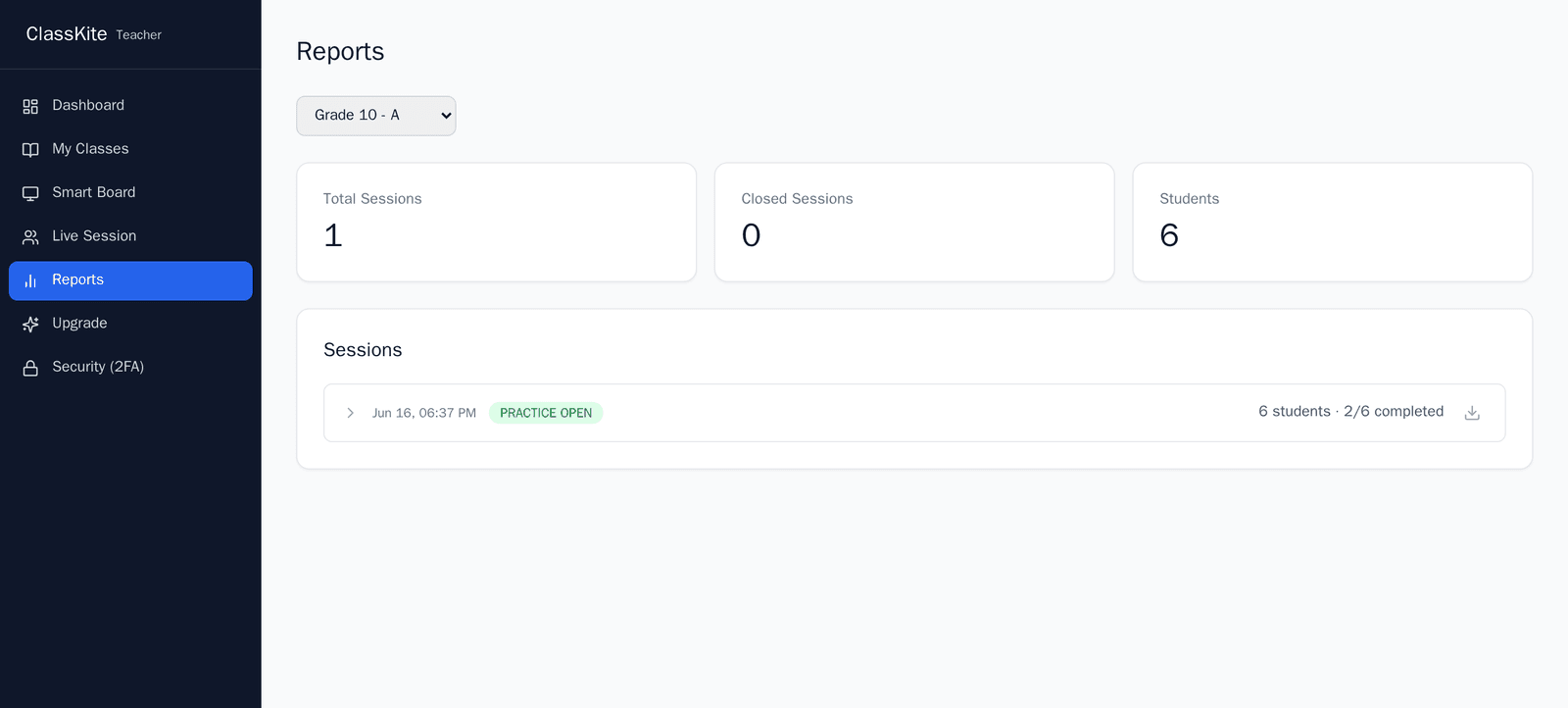
- Progress data you can actually use. Reports (Plus and School) give per-session completion, average and first-try accuracy, plus per-student and per-question breakdowns, a sessions log, a score-trend chart and CSV export. That makes it far easier to spot a question the whole class found hard. (To be clear, ClassKite reports the numbers — it doesn't produce automated "learning-gap analysis" or tell you what to do next.)
None of this requires abandoning what you already have — which leads to the most realistic position for most schools.
The hybrid reality
The choice is rarely "paper or screens" in the absolute. The practical middle ground is to keep your trusted resources and make those interactive.
ClassKite renders your existing PDFs exactly as they'd print, then layers interactivity on top — so you're not rebuilding a single worksheet. A teacher can annotate live over the page with a pen (a plain, constant-width pen), calligraphy ink, a highlighter, shapes and sticky notes, scroll continuously and zoom in, with offline support if the connection drops. The same file can then drive live practice where students answer on their own devices. You keep the materials your department trusts; what changes is what they let you see and do.
For a department, hybrid often means paper for quick, low-stakes or handwriting-heavy tasks, and digital where instant feedback, live visibility or a record of progress genuinely helps. For more on turning an existing file into practice, see our guide on how to create digital practice from a PDF.
Questions to ask before switching
Test the decision against your real context, not the brochure. A short checklist for a head of department or leadership team:
- Devices. Do students have access to devices when they'd need them — one each, shared sets, or bring-your-own? Where there are none, paper still wins for that task.
- Connectivity. Is your wifi reliable in the rooms that matter? (Offline support helps when it drops, but a baseline still matters.)
- Teacher buy-in. Will staff actually use it? A tool that keeps existing worksheets and requires no rebuilding is far easier to adopt than one that demands new materials.
- Data and privacy. Are you comfortable with how student data is handled, and can you explain it to parents and governors?
- Cost model. Does the pricing match how you're organised — by department, by year group, or whole-school — and is the billing simple to administer?
- Rollout. Can you start small, prove the value and expand, rather than committing the whole school on day one?
If most answers are positive for at least some of your teaching, a focused trial is reasonable. If several are shaky, fix those first.
Cost and rollout
For schools, ClassKite is billed per seat in blocks of 15, monthly or annually (the annual option is discounted), on a single invoice for the whole school, payable by Stripe or PayPal. Importantly, students are free — they join a class with a class code and need no paid accounts — so your seats cover teaching staff, not pupils.
Rollout doesn't have to be all-or-nothing. A sensible pattern: start with one department, prove the value over a half-term, and expand from there. Bulk Excel import brings in teachers, classes and rosters without manual data entry, and the admin console handles seats and roles, with role-based access for students, teachers, school admins and a super admin. Because everything runs in the browser on smart boards, laptops and tablets, there's nothing to install or maintain on each device. Full details are on the schools page and in our pricing overview.
What this means for a school
Stepping back from individual features, the school-level case for hybrid comes down to four things: consistent resources shared across a department rather than diverging photocopies; live insight into who's struggling while the lesson is still happening; time back from photocopying and from auto-scored objective questions; and a single place to manage seats, roles, classes and reports. It also means keeping the materials staff already trust — the switch is in workflow, not in throwing away years of resources. If reducing the marking burden is a particular pressure, our note on how to reduce marking time goes into more detail.
In the classroom
Consider, illustratively, a science department preparing a topic test. They upload an existing revision PDF — no rebuilding — and add a short set of multiple-choice and numeric questions, which objective questions auto-score on submission. During the lesson, the teacher watches the Live Student Grid: two pupils raise help flags, and three are flagged as struggling on the same balancing-equations question. The teacher pauses, reteaches that one idea on the smart board, and moves on. Afterwards, the report shows the class average and, per question, exactly where accuracy dipped — useful evidence for the next department meeting, exported to CSV if needed. The worksheet was familiar; what changed was the visibility around it.
Frequently asked questions
Do students need devices and logins?
For live practice, yes — students answer on their own devices. But they join with a class code and need no paid accounts, which keeps sign-in simple. Where devices are scarce, you can still use ClassKite on the smart board for teaching and annotation, and keep paper for tasks that don't need a screen.
Can we keep our existing worksheets?
Yes. ClassKite renders your existing PDFs as they'd print, then layers interactivity on top. You annotate and build practice on the materials you already have rather than recreating them.
How is student data handled?
Connections use HTTPS, passwords are salted and hashed, sign-in is rate-limited, and access is role-based. Data runs on EU infrastructure, and we don't sell personal data or carry third-party ads. You can read more on our trust page; for specific procurement or data questions, get in touch.
Can we start with one department?
Yes — that's the recommended approach. Seats are bought in blocks of 15, so a single department can trial it, and bulk import plus the admin console make it straightforward to add more teachers and classes when you're ready to expand.
Talk to us
If you're weighing paper against digital for your school, the most useful next step is a conversation about your context — devices, connectivity and how your departments are organised. Book a school demo, explore what's included for schools, and review the options on our pricing page. If you're new to the platform, what is ClassKite? is a good place to start.
Written by the ClassKite team and reviewed by a practising teacher.