
How to Reduce Marking Time as a Teacher
Marking is the tax you pay after every lesson. You plan it, teach it, set the practice — and then, usually late in the evening, sit down with a stack of books to find out what landed. It works, but it's the slowest way to learn what your class understood. By the time you've ticked to the bottom of the pile, the moment to act has passed. This article is about marking less without learning less, and spending the time you save where your judgement genuinely matters.
The real cost of marking
The obvious cost is the hours — evenings, weekends, the free period meant for something else. The hidden cost is bigger. Marking is feedback delayed. When a class sits work on Monday and gets it back on Thursday, the gap between mistake and correction is days wide. Misconceptions have set, and the lesson that could have fixed them has already gone.
There's a cost to consistency too. A long session is tiring, and tired marking drifts — the first script and the fortieth rarely get the same attention. And much of what you mark is mechanical: right or wrong, B or C, is the total correct. That's exactly the work a computer does quickly and consistently — which is the point of what follows.
Five ways to mark less
-
Auto-score the objective questions. Multiple choice, numeric answers and short answers have a single correct response, and those are the questions you should never mark by hand again. In a live ClassKite practice, students answer on their own devices and objective questions are scored instantly, with points awarded as they go. That slice of the marking is simply done — finished the moment the student submits, not deferred to the evening.
-
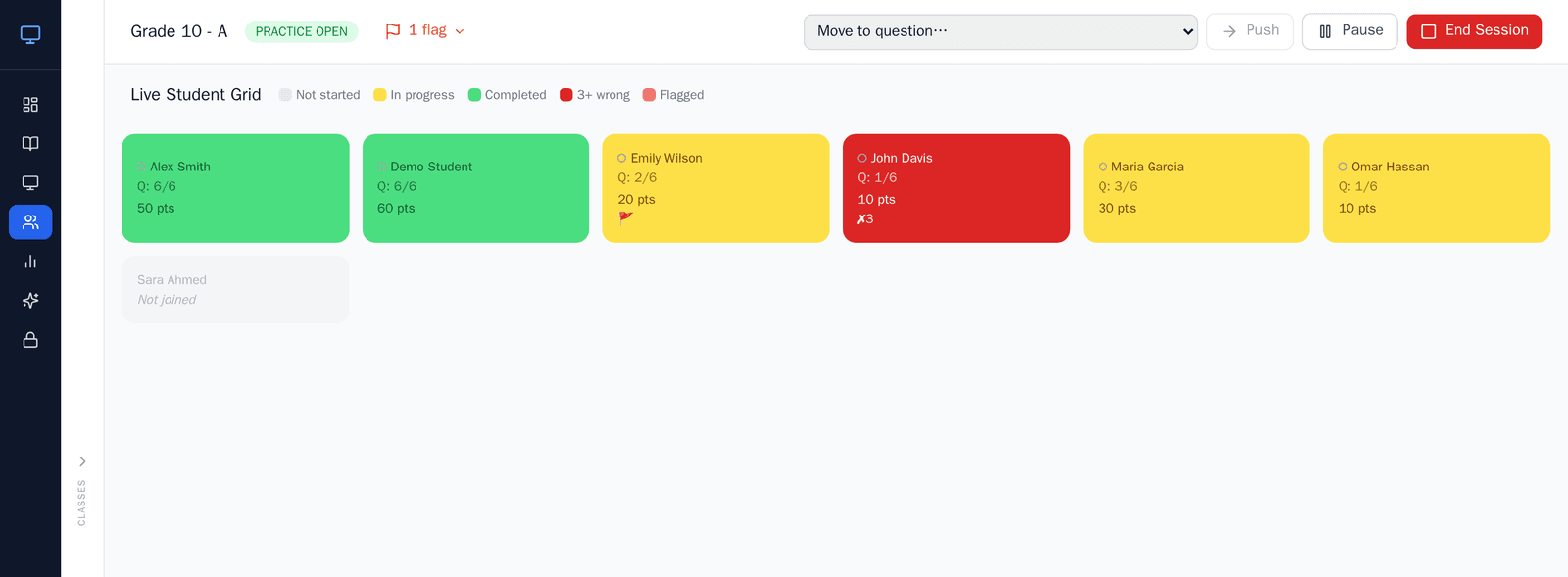
See mistakes live, while you can still act. The slow part of marking isn't the ticking; it's finding out too late. With the Live Student Grid (Teacher Plus and School plans), you watch progress and scores update in real time, see who's raised a help flag, and get a "struggling" signal when a student keeps getting the same kind of question wrong. You're reading the class as it works, so a reteach happens in the lesson rather than in a comment they may never read.
-
Reserve your time for human-judgement work. Once the machine has handled the right/wrong questions, the time you'd have spent on them is freed for the marking only a teacher can do: the extended answer, the reasoning, the working that's almost right. That's the marking that changes how a student thinks, and it deserves your full attention precisely because you're no longer ticking boxes.
-
Reuse scored practice instead of rebuilding it. A practice you've built and run doesn't expire. Assign the same set to another class, to next year's cohort, or as revision, and the objective questions score themselves again with no extra marking. You author once; the saving repeats every time you reuse it. The same goes for uploaded PDFs and slides, which stay reusable across classes.
-
Let reports do the summarising. After a session you usually need a summary: who completed it, the class average, which questions tripped people up. ClassKite reports (Plus and School) compile per-session completion, average and first-try accuracy, plus per-student and per-question breakdowns, a sessions log, a score trend, and CSV export. That's the tallying-up handled for you — not an automated analysis of learning gaps, but the figures laid out so you can draw the conclusions quickly.
What to auto-mark and what to keep for yourself
The decision is simpler than it sounds: auto-mark anything with one defensible correct answer, and keep anything that needs a teacher's judgement.
Hand ClassKite the multiple-choice questions, the numeric calculations, the short factual recall and the fill-in-the-blank items — including those with LaTeX maths. They're scored consistently and instantly, and there's no benefit to marking them by hand.
Keep for yourself the extended writing, the open reasoning, the multi-step problem where the method matters as much as the answer, and anything where a "wrong" final answer might still contain good thinking worth crediting. ClassKite doesn't auto-mark open-ended or extended responses — the teacher marks those — and that's by design. A rule of thumb: if you could write a single key that any colleague would mark identically, automate it; if marking it well needs your professional judgement, it stays with you.
The same line applies when you build questions with the AI question generator. You give it a topic, a count and a difficulty; it drafts multiple-choice and fill-in-the-blank questions; then you review and edit every one before it's assigned. Nothing is assigned automatically, and the AI never marks student work — it just gives you a faster start on the objective questions that will later score themselves.
Before and after
Before: you set a worksheet, collect it in, and carry it home. You mark every question by hand, including the forty multiple-choice items that only needed a tick or a cross. You spot a recurring misconception around the middle of the pile — too late to do much before the next lesson. You write a markbook summary by counting up totals yourself.
After: students complete the practice on their devices, and the objective questions are scored as they go. You watch the Live Student Grid and reteach the tricky idea on the spot, while it still matters. At home, your marking is only the extended answers — the work that genuinely needs you. The session report has already tallied completion, first-try accuracy and the per-question pattern, so your summary is a glance rather than a sum.
The common mistake: don't auto-mark everything
The trap is treating automation as the goal rather than the tool. Once auto-scoring is saving you time, it's tempting to convert every question into multiple choice so nothing's left to mark by hand. Resist it. Open reasoning, justification and extended writing are where a lot of real learning shows up, and forcing them into a tick-box format quietly narrows what you're assessing.
Auto-mark to clear the mechanical work, not to avoid the thoughtful work. The aim is to spend less time ticking and more on the marking that changes how a student thinks — not to remove that marking altogether.
In the classroom
Picture a science teacher running an end-of-topic check (an illustrative example). She builds a practice mixing fifteen objective questions — multiple choice on key terms, a few numeric calculations — with two extended "explain why" questions. She drafts the objective items with the AI generator, edits two that are too easy, and assigns the set.
During the lesson she watches the Live Student Grid. Three students raise help flags on the same calculation, and the grid marks two more as struggling on it. She pauses, works it through on the board, and the class moves on. By the time the bell goes, every objective question is already scored. That evening her marking is two short explanations per student — and nothing else. The session report tells her, at a glance, that the class handled the vocabulary well but one calculation needs revisiting next lesson.
Frequently asked questions
What can be marked automatically?
Objective questions with a single correct answer: multiple choice, numeric answers, short answers and fill-in-the-blank items, including those using LaTeX maths. These are scored instantly during a live practice, with points awarded as students submit.
Does ClassKite mark essays?
No. Open-ended and extended responses aren't auto-marked — the teacher marks those. ClassKite is built to take the mechanical marking off your plate so you can give the writing and reasoning the attention it needs.
How do I give feedback faster without auto-marking everything?
Use the live view. The Live Student Grid surfaces help flags and a "struggling" signal as students work, so you can step in during the lesson instead of writing comments after it. For the work you do mark by hand, the auto-scored questions are already done, so your time goes entirely to the answers that need judgement. There's more in our guide to tracking student progress during live practice.
Which plan includes live reports?
The Live Student Grid and reports are available on Teacher Plus and School plans; students always join free with a class code. Compare what's included on the pricing page, and schools can read about per-seat billing and the admin console on the schools page.
Mark less, teach more
Reducing marking time isn't about cutting corners — it's about putting your attention where it counts. Let the objective questions score themselves, read your class live while you can still act, and keep your marking for the work that genuinely needs a teacher. To try it with your own questions, sign in and build a practice, and see the pricing page for the plans that include live reports. If you're weighing it up for a department, read how ClassKite saves teachers time or get in touch.
Written by the ClassKite team and reviewed by a practising teacher.