
What Is ClassKite? A Classroom Teaching and Practice Platform

ClassKite brings your teaching materials, live lessons and practice into one place. You upload the PDFs or slides you already use, present and annotate them on a smart board, generate practice questions with AI help (reviewing every one before it reaches a student), then send that practice to students, who answer on their own devices and join with a class code. Progress shows up as you teach, so you can see who's finished and who's stuck. Students never pay and never need an account. Here's what ClassKite does, who it's for and how a lesson flows from start to finish.
Who ClassKite is for
ClassKite is built for the way teachers actually work, not the way software vendors imagine teaching happens. If you teach a class, prepare materials in advance, present at the front of the room and set practice to check understanding, ClassKite fits around that routine.
For teachers, it's a single workspace: upload materials, teach with them live, generate and assign practice, and watch responses come in. For students, it couldn't be simpler — they open a link, type a class code and start answering on a phone, tablet or laptop. Nothing to install, no password to forget, because students don't need accounts at all. For schools, ClassKite offers a consistent workflow across departments plus the management tools — bulk import, an admin console and role-based access — that make rolling it out across many classes practical. There's more on the school side on the ClassKite for schools page.
The problems it solves
Most teachers run a patchwork of tools: a PDF viewer for the textbook, a slideshow app for presenting, a worksheet generator for practice, a messaging tool to send links, a spreadsheet to track who did what. Each works on its own, but moving between them is where the time goes — re-uploading the same document, copying questions out, chasing missing answers, typing marks into a grid.
ClassKite collapses that patchwork. Materials, teaching and practice live in the same place, so the document you annotate on the board is the document you build practice from. Practice is created quickly rather than typed out by hand. Answers come back structured — multiple choice and fill-in-the-blank — so they're marked instantly and you're not deciphering handwriting at 9pm. And because responses arrive live, progress is visible while you can still do something about it.
What you can do with ClassKite
ClassKite is organised around a small set of capabilities that work together.
Upload and annotate materials. Upload PDFs; every page renders exactly as it would print. Write over them live with a pen, a calligraphy ink tool for a handwritten feel, a highlighter and an eraser; drop in shapes (rectangle, ellipse, arrow), text boxes and sticky notes; scroll continuously through long documents; pinch or wheel to zoom. Annotations are kept on your device and keep working offline; tap Save to store them on the server. See PDF annotation for more.
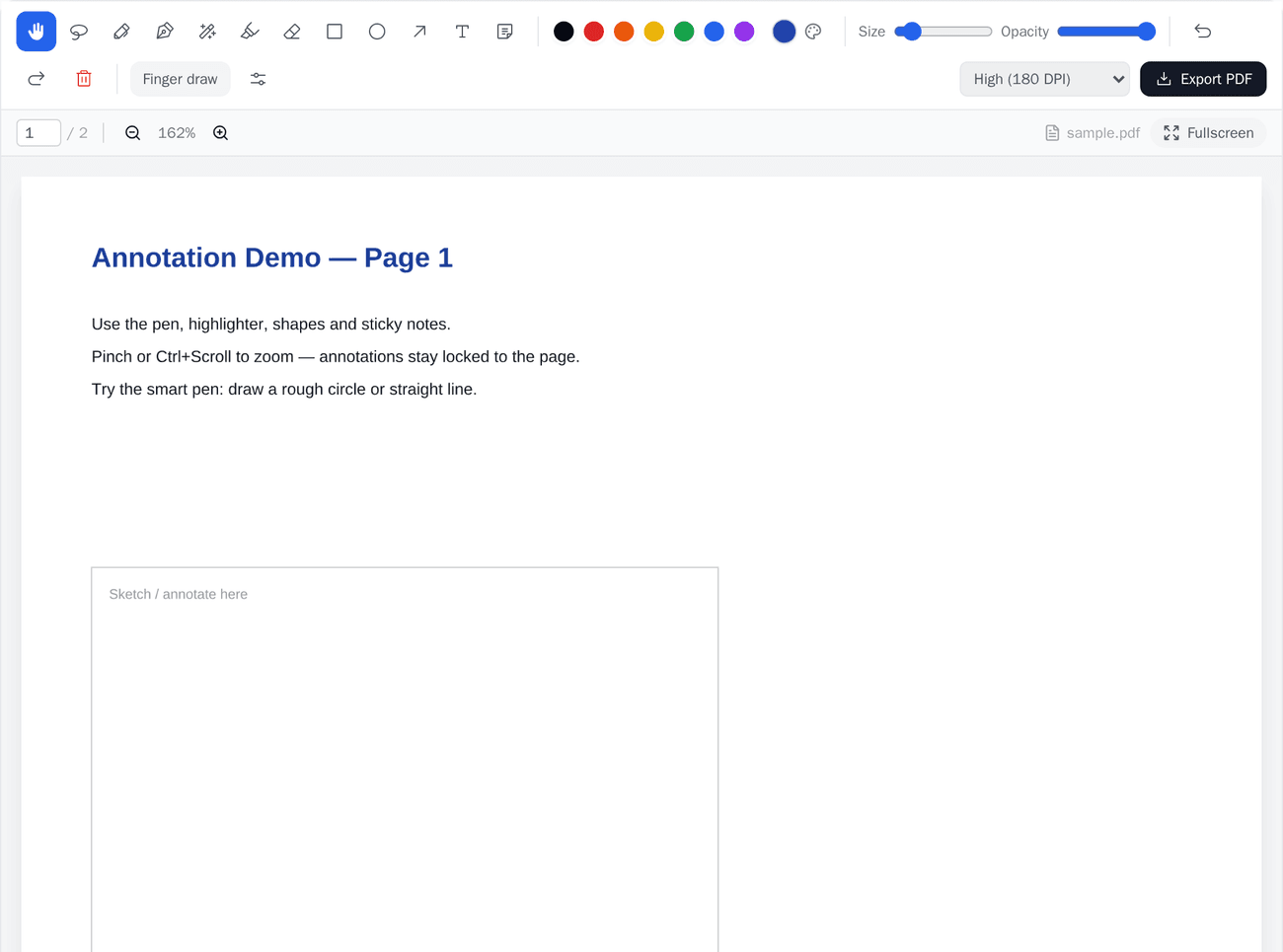
Teach with smart-board mode. Present any document full-screen and annotate as you go. With smart-board teaching, follow-me page sync keeps students' screens on the same page as yours, your strokes stream live to their devices, and you can push a single question — or a whole practice set — mid-lesson without breaking your flow.
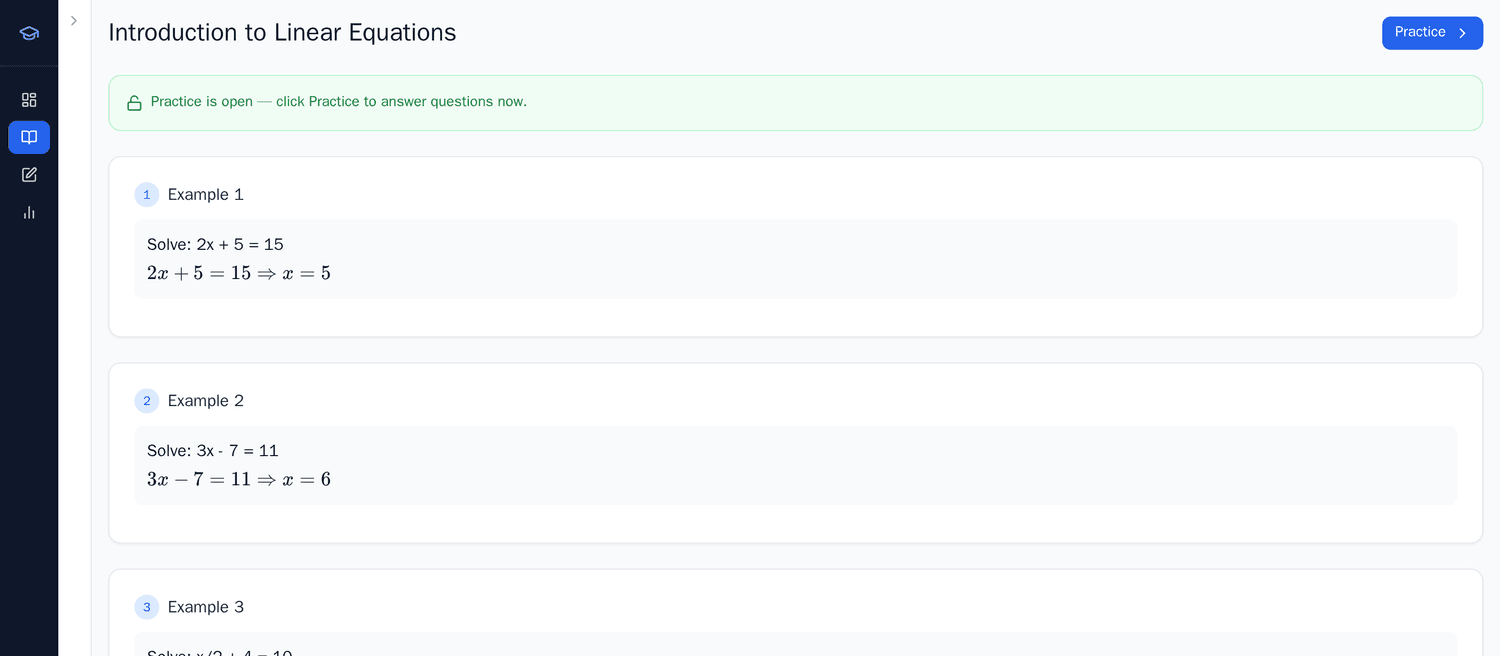
Build practice three ways, then review it. Create questions however suits you: import them from an AI agent — hand your AI assistant the downloadable Question Bank template and your material, and it drafts matching questions in the template's format — use the built-in AI question generator (topic, count and difficulty → a drafted set), or write them yourself. Crucially, you review and edit every question — wording, choices and the answer key — before anything is assigned. Nothing is auto-assigned, and ClassKite never marks a test for you without your sign-off. Questions can be multiple choice or fill-in-the-blank (words or numbers), with LaTeX support for maths.
Send practice and watch responses. With live practice, students answer on their own devices and get instant right/wrong feedback and points. A one-tap help flag lets a student signal they're stuck, and you can run a session teacher-paced (everyone moves together) or self-paced.
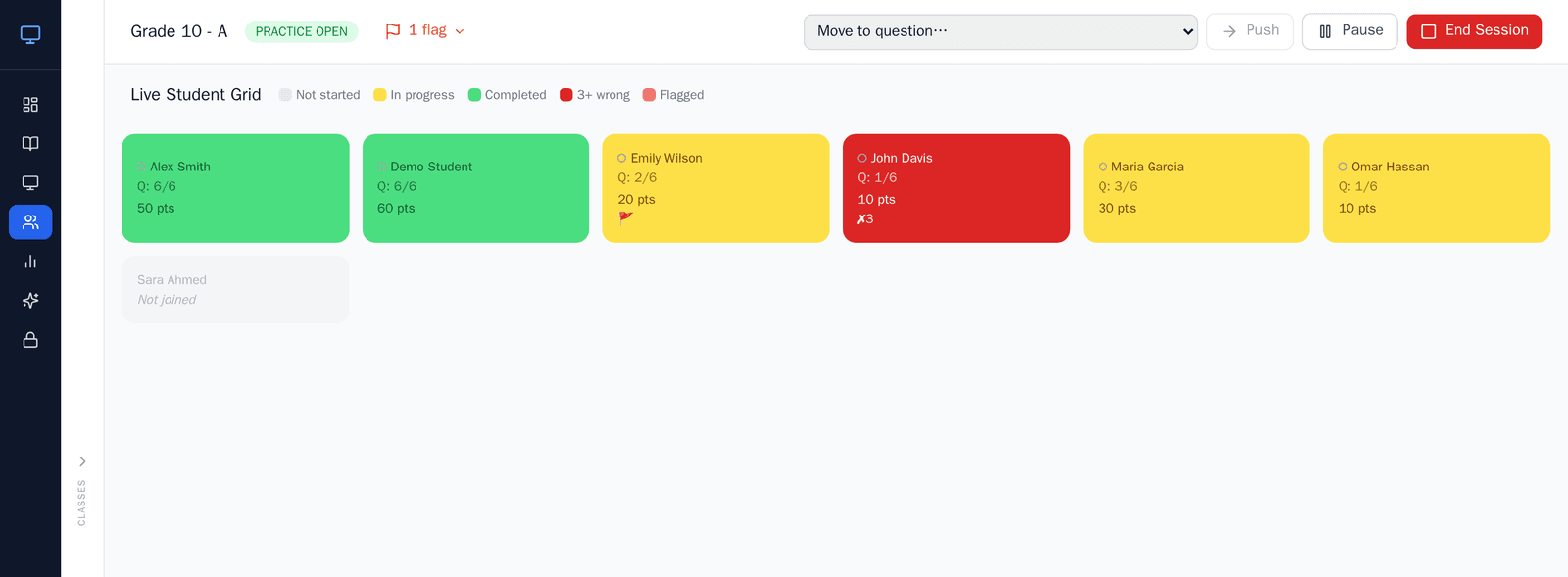
Monitor progress and review reports. On Teacher Plus and School plans, the Live Student Grid shows real-time per-student status — in progress, completed or flagged — with a "struggling" signal when a student gets repeated answers wrong, online/away presence, and questions completed plus score. Click any student to see their attempt history. Afterwards, reports give per-session completion, average score and first-try accuracy, per-student and per-question breakdowns, a sessions log, a score-trend chart and CSV export.
How a ClassKite lesson flows
A typical lesson moves through four stages.
- Prepare. Upload the PDF or slides you're teaching from, and optionally draft a few practice questions with AI, reviewing and editing each one.
- Teach. Open smart-board mode, present full-screen and annotate as you explain. Students' screens follow your page.
- Practise. Push a question or a whole set to the class. Students answer on their devices and see instant feedback.
- Review. Watch the Live Student Grid as answers arrive, then check the session report to see who understood and who needs another go.
For a fuller walkthrough, see how teachers use ClassKite, step by step.
Why it matters
The point of all this isn't novelty — it's to give you back attention. Preparing a lesson takes less shuffling between apps. Practice stays organised, because the questions, the answers and the results all sit alongside the material they came from. And because progress is visible as it happens, the students quietly falling behind become visible too, while there's still a lesson left to help them. ClassKite doesn't replace your judgement about what to teach or how; it removes some of the friction around it. For the practical version, our guides on saving time and reducing marking go into more detail.
ClassKite for schools
For a department or whole school, ClassKite adds the parts that make consistency manageable. Billing is per seat in blocks of 15, monthly or annually (annual is discounted), on a single invoice, paid by Stripe or PayPal. You can bulk-import staff and classes from Excel, manage everyone from an admin console, and rely on role-based access for students, teachers, school admins and super admins. Students remain free. The schools page and pricing have the specifics, and paper versus digital worksheets is a useful read for leadership teams.
In the classroom
A Year 9 science teacher might upload the lesson's slides on photosynthesis, present them on the board and annotate the leaf diagram live as the class follows along. Near the end, she pushes a quick six-question check — a mix of multiple choice and fill-in-the-blank she drafted with AI and tidied up that morning. As students answer on their tablets, the Live Student Grid flags two who keep getting the role of chlorophyll wrong, so she pauses to re-explain before the bell. The session report, exported later, shows exactly which question tripped people up.
Frequently asked questions
Is ClassKite free for teachers?
You can create a teacher account and use the core tools at no cost. Some features — the Live Student Grid and the fuller reports — are part of the Teacher Plus and School plans. Compare what each tier includes on the pricing page.
Do students need an account?
No. Students join a session with a class code on their own device, and they answer without ever creating a paid account. Students are free, always.
What subjects does it work for?
ClassKite is subject-agnostic. Because it works from your own PDFs and slides and supports multiple choice, fill-in-the-blank (words and numbers) and LaTeX maths, it suits English, the sciences, languages, maths and beyond — anywhere you teach from materials and set practice.
Is it for individual teachers or whole schools?
Both. An individual teacher can sign up and use it for their own classes, and a school can roll it out across departments with bulk import, an admin console and a single invoice. The for teachers and schools pages cover each route.
Want to try it? You can create a free teacher account and upload your first document in a few minutes. School leaders looking at a wider rollout can find seat pricing and admin details on the ClassKite for schools page, or get in touch with any questions. We take privacy seriously too — read how we handle data on our trust page.
Written by the ClassKite team and reviewed by a practising teacher.